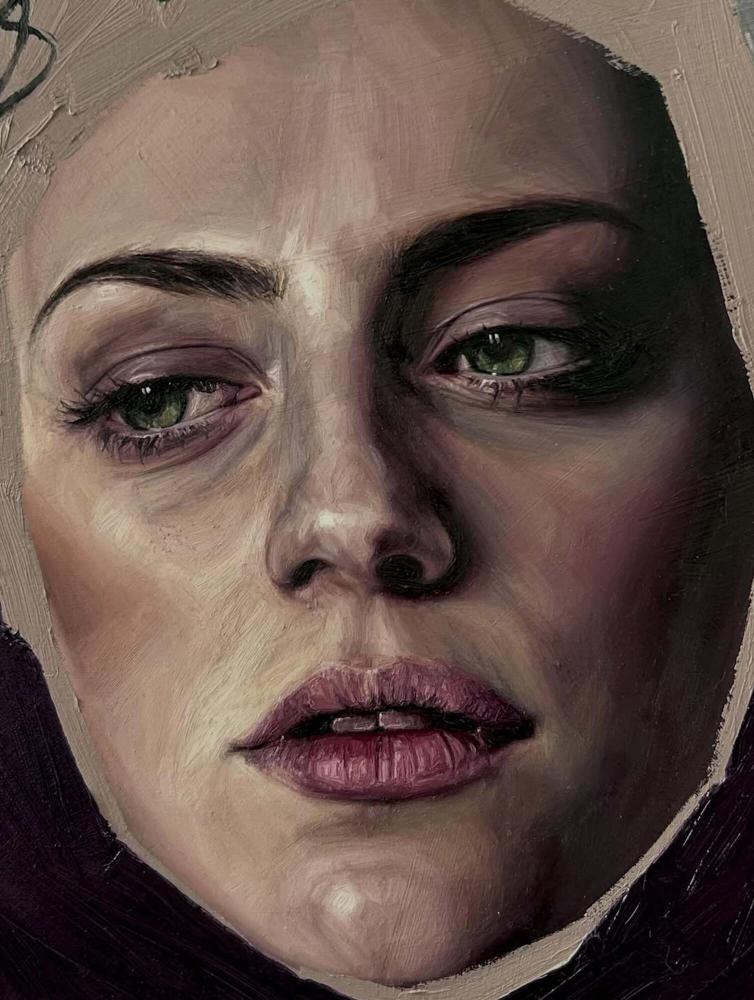
Louise Howard belongs to a generation of British painters who treat oil paint not as a means to an end, but as a subject in its own right. Born in the United Kingdom in 1982, she has built a practice around a single, sustained inquiry: the human face, rendered with technical precision and then pressed against the raw, disruptive force of abstract mark-making. Her work occupies the territory where classical figuration meets material chaos, and it does so with a confidence that has begun to attract serious attention from collectors and curators alike.
What follows is a considered look at her philosophy, her methods, and a small selection of works drawn from her ArtRewards profile. These pieces have been chosen not to catalogue her output, but to illuminate the central tensions that define it.
A Practice Built in the Studio
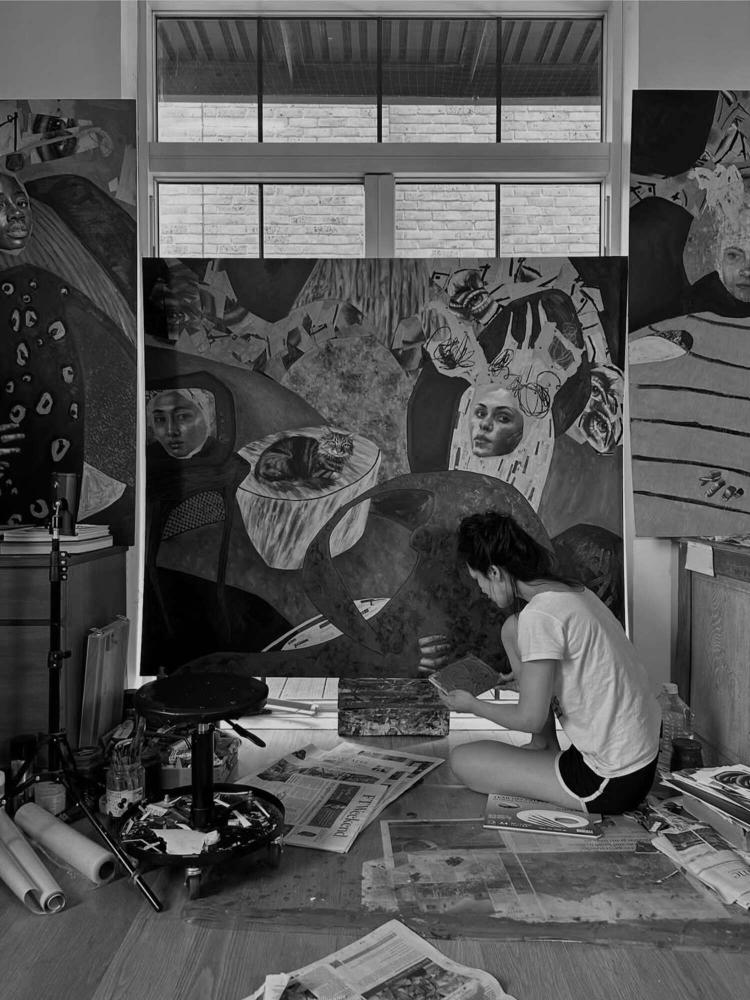
Howard's route into professional painting was neither sudden nor accidental. By her own account, she has always been creative; the decision to pursue art professionally was about ownership, about treating the work with the seriousness she felt it deserved. There was no epiphany, only an innate drive sustained over nearly two decades of practice.
Her formal education followed a familiar arc until it abruptly diverged. After studying art throughout her schooling, she enrolled at the Surrey Institute of Art & Design, only to leave after three months. The institution, she felt, was not engaged with what she actually wanted to do: paint. That departure proved formative. Her real training has been entirely hands-on, accumulated across thousands of hours at the canvas, learning the physical mechanics of oil paint on her own terms.
This self-directed apprenticeship matters because it explains the particular character of her surfaces. Howard did not inherit a house style. She built her technique through trial, repetition, and a willingness to sit with failure. The result is a method that feels earned rather than taught, and a relationship with her chosen medium that borders on the intimate.
Why Oil, and Why the Face
Howard works exclusively in oil. She is drawn to its weight, its slow drying time, and the depth it allows. These qualities are not incidental preferences; they are the foundation of her aesthetic. Oil's reluctance to dry permits a prolonged negotiation with the surface, a process of pushing, scraping, and rebuilding that faster media simply cannot support.
The face is her constant focus. Her stated subject is the human form, with particular attention to the face, and she is candid about seeking out features that are unusual or not conventionally beautiful. The people she paints are not professional models. They are ordinary individuals in whom she finds something worth examining.
Crucially, Howard insists there is no explicit story behind the work, and she would not want there to be. This refusal of narrative is one of the most distinctive aspects of her position, and it shapes how her paintings invite reading. They are not illustrations of events. They are objects to be confronted.