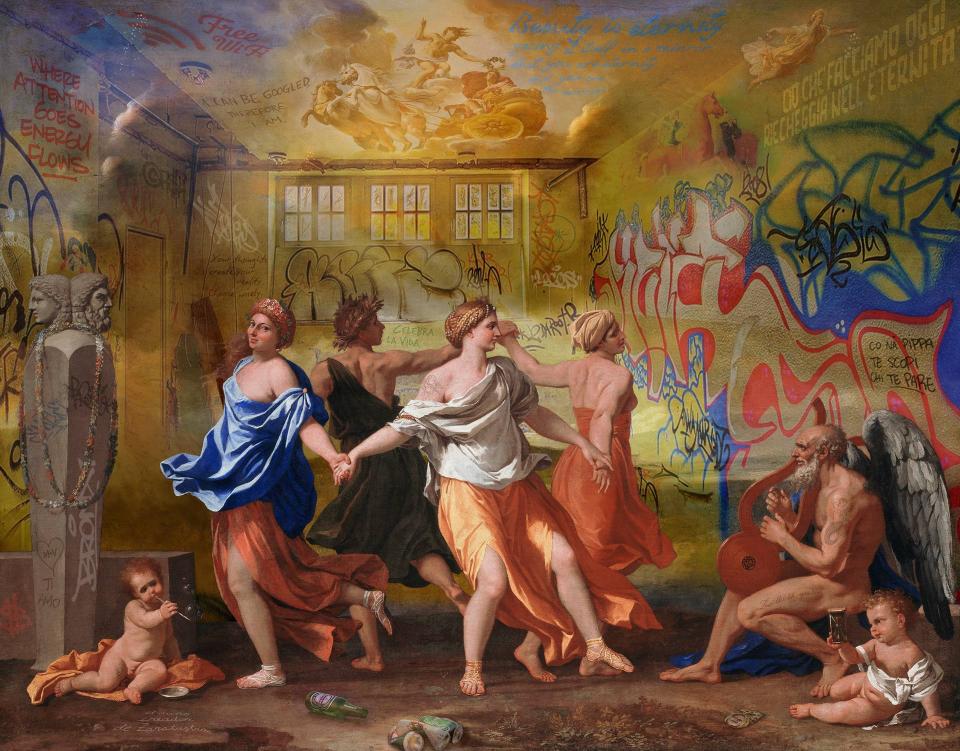
In the contemporary landscape of visual art, few practitioners navigate the complex intersection of classical antiquity and modern urban vernacular with the precision of Marco Battaglini. Born in Verona, Italy, in 1969, Battaglini has established a profound aesthetic paradigm that challenges established chronological and cultural boundaries. His overarching artistic project, often referred to as the "Battaglini Universe" or "The New Mythology," operates as a sophisticated dialectic between the sacred and the profane. By synthesising Renaissance idealism with the chaotic visual lexicon of contemporary street culture, Battaglini creates a compelling visual language that recontextualises art history for the postmodern era.
This article provides a comprehensive academic and professional exploration of Battaglini’s methodology, an examination of his theoretical framework as articulated in his manifesto, and a detailed critical analysis of selected masterpieces currently curated on the ArtRewards platform.
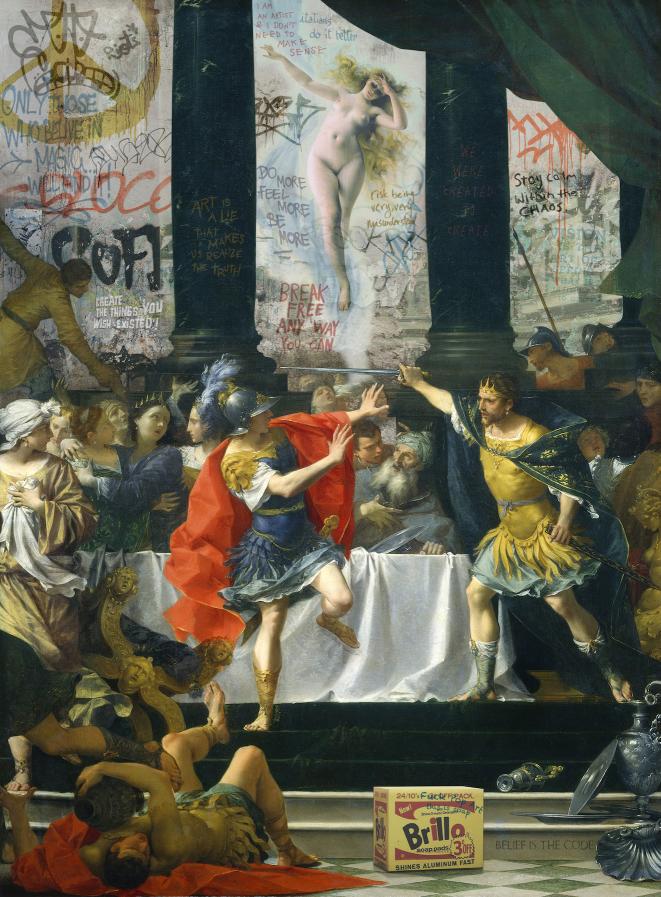
The "New Mythology" Methodology and Theoretical Framework
Battaglini’s artistic methodology is firmly rooted in a philosophical framework he defines as "The New Mythology." As delineated in his manifesto and associated writings, this methodology does not treat art as mere aesthetic decoration, but rather as an intellectual and spiritual awakening. The core of this methodology is the concept of memory, specifically, a collective, cultural memory of beauty and divinity that has been obscured by the rapid pace and fragmentation of contemporary society.
The "New Mythology" posits that the deities and archetypes of classical antiquity have not vanished; rather, they have metamorphosed, adapting to the visual and cultural codes of the modern metropolis. Battaglini articulates this through specific archetypal figures: the Urban Angel, representing inner awakening; the Tattooed Warrior, signifying identity forged through modern experience; the Rebel Venus, embodying sensuality intertwined with contemporary consciousness; and the Contemporary Saint, illustrating spirituality persisting amidst modern chaos.
In this methodological approach, the medium is intrinsically linked to the message. Battaglini frequently employs classical imagery because it encapsulates what he terms an "immortal spiritual code", the zenith of human aspiration. However, he deliberately contaminates these pristine forms with graffiti, tattoos, and urban symbols. Within Battaglini’s methodology, the tattoo serves as a critical signifier of identity, rebellion, and vulnerability. By superimposing tattoos onto figures rendered in the style of classical marble or Renaissance portraiture, he symbolically injects the contemporary human spirit into historical stone. This is not an exercise in historical nostalgia, but rather a deliberate resurrection of classical forms within the immediate, tangible present.